Ford GT40 Heritage: The Car That Took On Le Mans
How Ford's GT40 won Le Mans four years running from 1966 to 1969, what the Mk I, Mk II and Mk IV were, where to see one in the US and how to photograph it at historic events.

The Ford GT40 is the car that turned an American manufacturer into a Le Mans winner. Between 1966 and 1969, GT40-based cars won the 24 Hours of Le Mans four years in a row, beating Ferrari at the race it had dominated. Half a century later, the GT40 is one of the most recognizable race cars in the world and a highlight at any historic event or museum where it appears.
Why Ford wanted Le Mans
In the early 1960s, Ford wanted a performance image to match its sales strength, and endurance racing was the stage that mattered. After talks about acquiring Ferrari fell through, Ford set out to build its own car to beat Ferrari at Le Mans. It was a big target: according to The Henry Ford, Ferrari won 8 of the 12 Le Mans races from 1954 through 1965. The program drew on British expertise: the early development work involved Eric Broadley of Lola and a base in England, and the car’s name came from its height of about 40 inches.
The early years and the Mk II breakthrough
The first cars were fast but fragile, and the early Le Mans attempts in 1964 and 1965 ended without a win. Ford then handed more of the racing program to Carroll Shelby’s Shelby American and fitted a larger 7.0-liter V8 to create the Mk II.
In 1966, the Mk II delivered. Ford finished 1-2-3 at Le Mans, with Bruce McLaren and Chris Amon taking the win for Shelby American. The finish, with the Ford cars crossing the line together for a staged photo, remains one of the most debated moments in the race’s history, because it cost Ken Miles and Denny Hulme the victory: McLaren and Amon had started further back, so they were judged to have covered more distance. It’s also a reminder that the history of a race is often shaped by its photographs.
1967: the all-American win
For 1967, Ford brought the Mk IV, a new design developed in the US. Dan Gurney and A.J. Foyt won Le Mans in it. The Henry Ford describes it as the first all-American car and team to win the race, and credits Gurney’s post-race celebration with racing’s first champagne spray. The winning car, chassis J-5, is preserved, not restored, at The Henry Ford in Dearborn, Michigan, where it carries the wear of the race.
1968 and 1969: Gulf colors
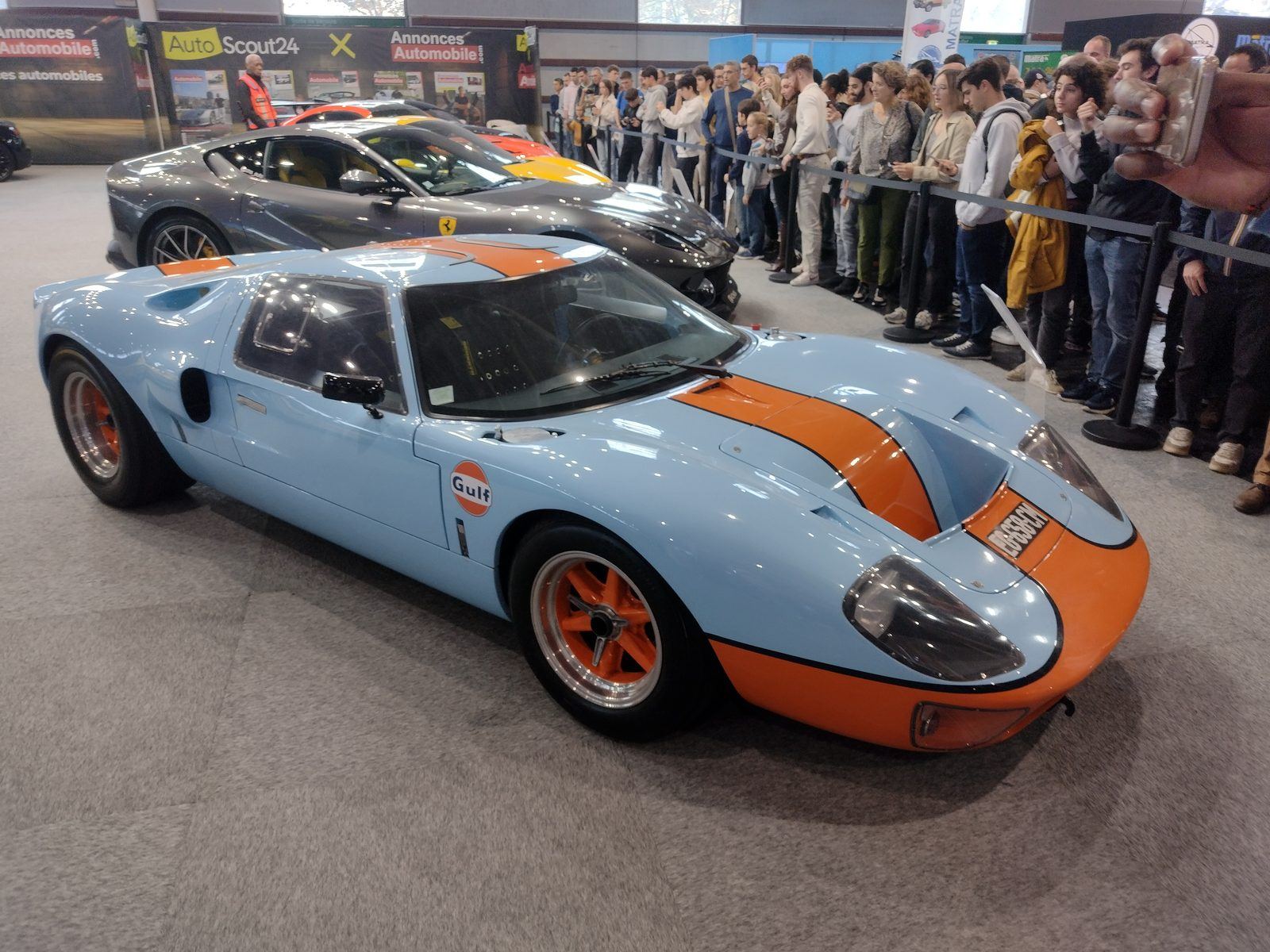
Rule changes for 1968 limited engine sizes for sports cars, which ruled out the big-engine Mk IV. The older Mk I design, run by John Wyer’s JW Automotive in the now-famous light blue and orange Gulf livery, took over. Pedro Rodríguez and Lucien Bianchi won in 1968, in a race held in September that year. In 1969, Jacky Ickx and Jackie Oliver won in the same chassis, number 1075, finishing just ahead of a Porsche 908 after one of the closest finishes in the race’s history.
That gave chassis 1075 two Le Mans wins, and it made the Gulf livery a permanent part of car culture. If you see a GT40 in blue and orange at an event, it’s almost certainly paying tribute to those cars.
The legacy: from GT to GT
Ford revived the name for road cars with the Ford GT of the mid-2000s and then a new Ford GT in 2016. The second-generation car returned to Le Mans and, 50 years after the 1966 win, won the GTE Pro class in 2016 with the No. 68 car driven by Joey Hand, Dirk Müller and Sébastien Bourdais. Ford’s factory GT program ran until 2019. The official 24 Hours of Le Mans site and The Henry Ford’s collections are reliable places to check results and details.
Where to see a GT40 in the US
Original GT40s are rare and valuable, so most appear at museums, concours events, auctions and historic races. Good places to look:
- Museums with racing collections, such as The Henry Ford in Dearborn, Michigan.
- Historic racing events, where GT40s compete in sports car classes, often alongside period rivals.
- Concours events and car weeks, such as Monterey Car Week in August.
- Collector car auctions, where you can usually see the cars up close during the preview days.
- Car meets, where continuation cars and replicas show up more often than originals. Our guide to exotic car runs and car meets covers how to find them.
Be careful with captions. Many GT40s you’ll see are licensed continuation cars or replicas. Unless the event program or the owner confirms it’s an original, caption it as a GT40, a GT40 continuation or a replica, as appropriate.
How to identify the versions
- Mk I: the classic shape, smaller engine, often in Gulf livery when you see it at events.
- Mk II: similar shape with changes for the bigger 7.0-liter engine. Look for the cooling scoops and the 1966 liveries.
- Mk IV: longer, with a different, more streamlined body. It looks distinct from the Mk I and II.
- Ford GT (2005-2006 and 2017 onward): modern road cars inspired by the GT40; the second generation has a dramatic flying-buttress rear.
Why the GT40 still matters to enthusiasts
The GT40 is more than a successful race car. Its story combines a manufacturer’s ambition, international engineering cooperation, a famous rivalry and a series of wins at one of the toughest races in the world. That mix is why the car continues to appear in books, films, museums and historic races.
For photographers, the GT40 is a reminder that the most compelling car images often carry a story. A photo of a GT40 at speed on a historic circuit says something about endurance racing in the 1960s; a close-up of a worn steering wheel or a period racing number hints at the hours of driving behind it.
Planning a shoot at a historic racing event
Historic racing events often run several categories over a weekend, and GT40s usually compete in sports car or endurance classes. Check the timetable for qualifying and race sessions, and walk the paddock early, when cars are being prepared and teams are more relaxed.
- Use practice sessions to find the best corners and test your panning. Our camera settings for motorsport guide has starting values.
- Photograph the car in the assembly area before it goes out, when it’s still clean.
- After the race, look for dirt, oil and tired drivers: images that tell the story of endurance.
- Respect barriers, corner workers and the privacy of teams working in their garages.
The GT40 is low, so get down to its level for static shots; at only about 40 inches tall, it looks squashed from standing height. For action from the spectator side, read our guide on how to take racing photos. Combined with a few detail shots and some images of the car in the paddock, this gives you a complete story rather than a single action frame.
Frequently asked questions
How many times did the Ford GT40 win Le Mans?
Four times in a row, from 1966 to 1969. The Mk II won in 1966, the Mk IV in 1967, and the same Mk I chassis, 1075, won in both 1968 and 1969 in Gulf livery.
Why is it called the GT40?
The name refers to the car’s height of about 40 inches, combined with “GT” for grand touring.
Where can I see the 1967 Le Mans-winning Ford in the US?
The 1967 Ford Mark IV that Dan Gurney and A.J. Foyt drove to victory is in the collection of The Henry Ford in Dearborn, Michigan.
Is every GT40 at a car show an original?
No. Many are licensed continuation cars or replicas. Check the event program or ask the owner before captioning a car as an original.