The Best Camera Settings for Motorsport Photography
Starting camera settings for motorsport: shutter speeds for freezing and panning, aperture, auto ISO, autofocus modes, drive modes and stabilization, plus how to adjust them at the track.

No single set of camera settings works for every corner, car and light condition, but motorsport photography follows a few clear rules. Shutter speed decides whether a car looks frozen or fast. Autofocus decides whether it’s sharp. Everything else supports those two choices. This guide gives you starting values, explains why they work and shows how to adjust them during a race weekend.
Start with shutter speed
Shutter speed is the most important creative choice in motorsport photography. There are two basic approaches.
Freezing the action
A fast shutter speed freezes the car completely. It’s useful for cars coming straight toward you, for close action, for bikes and for moments like crashes, sparks or cars jumping over curbs.
- 1/1000 sec freezes most cars at speed.
- 1/2000 sec or faster for very fast cars filling the frame, or long telephoto lenses where any shake is magnified.
The downside: frozen wheels and a sharp background can make a race car look parked. Use fast shutter speeds when motion is shown in other ways, such as smoke, spray, a car bouncing on a curb or a dramatic angle.
Panning for motion
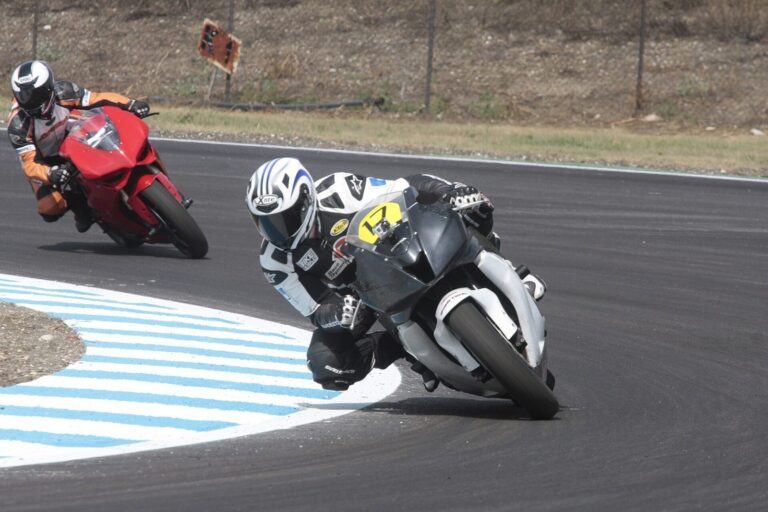
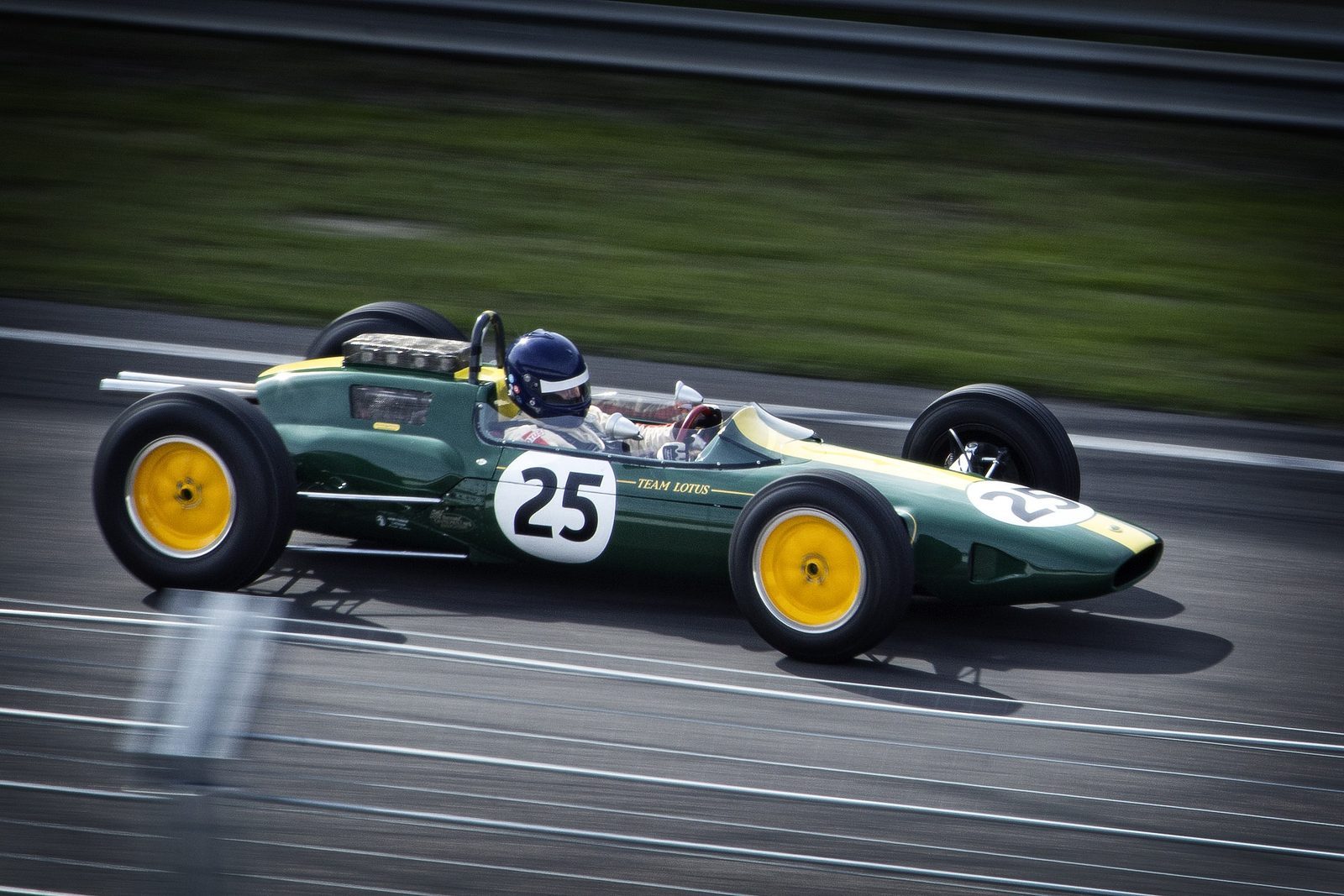
Panning means following the car with the camera at a slower shutter speed. The car stays sharp while the background and wheels blur. This is the signature look of motorsport photography.
- 1/250 sec: a safe start. Some background blur, a high hit rate.
- 1/125 sec: clear motion, still manageable for most people.
- 1/60 sec: strong blur, a lower hit rate.
- 1/30 sec and slower: for experienced panners or slow corners.
The right speed depends on the car’s speed and its distance from you. Fast cars far away need less shutter time for the same amount of blur than slow cars close to you. Our guide to photographing fast-moving subjects explains panning technique in more detail.
Wheel blur
Wheels turning look fast; wheels frozen look parked. Many photographers aim for at least some wheel blur. As a rough guide, shutter speeds slower than about 1/250-1/320 sec start to show it for cars at racing speed, though it depends on the wheel design and the car’s speed.
Aperture
Aperture matters less than in most other photography, because the car is usually far away and the depth of field is large.
- When freezing: shoot wide open or one stop down (f/2.8-f/5.6) to keep the shutter speed high and the ISO low.
- When panning: in bright light, slow shutter speeds force a small aperture (f/11-f/22). Small apertures show dust on the sensor and soften images through diffraction. An ND filter (2-3 stops) lets you stay around f/8.
ISO
Auto ISO is a good tool in motorsport, because light changes constantly as you move around the circuit and clouds pass. Use manual or shutter priority with auto ISO, and set a maximum ISO that you find acceptable for your camera. For modern full-frame cameras, ISO 6400 is often still usable; for smaller sensors, a lower limit may be better.
When the light is good, keep ISO low. For panning in daylight, you may need base ISO plus an ND filter.
Exposure modes
- Shutter priority (S or Tv): you set the shutter speed; the camera chooses the aperture. Simple and effective for panning.
- Manual with auto ISO: you set both shutter speed and aperture; the camera adjusts ISO. Good for freezing action with a fixed aperture.
- Full manual: best when the light is stable and you want consistent exposures, for example on a corner in constant sun.
Watch out for bright skies and white or black cars, which can trick the meter. Use exposure compensation or manual exposure when needed.
Autofocus
Autofocus is the difference between keepers and near misses.
- Continuous autofocus (AF-C, AI Servo or Servo AF). The camera keeps adjusting focus as the car moves.
- AF area: a zone or a small group of points works well for most cars. Wide areas can grab the background or barriers.
- Subject detection: many recent cameras can detect cars or motorcycles. It works well in clear views but can get confused by fences or multiple cars.
- Tracking sensitivity: set it so the camera doesn’t jump to a fence or another car passing through the frame.
- Back-button focus: separating focus from the shutter button makes it easier to keep tracking or to pre-focus on a spot.
When shooting through a fence, use a single point or a small zone, and get as close to the fence as safely allowed so the wires blur out.
Drive mode
Use continuous shooting. Short bursts as the car passes your chosen spot give you several frames to choose from. Don’t hold the shutter down for the entire pass; you’ll fill memory cards and buffers quickly. Use a fast memory card so the camera can write files while you keep shooting.
Stabilization
Image stabilization helps for both freezing and panning with long lenses. For panning, use a panning mode if your lens or camera has one; on Canon lenses, Mode 2 corrects shake perpendicular to the pan. For very fast shutter speeds, stabilization matters less but doesn’t hurt. Check your camera’s manual for the specific options.
Shutter type
Many mirrorless cameras offer an electronic shutter. It allows very high frame rates and is silent, but on cameras with slower sensor readout, fast-moving cars and turning wheels can look distorted (rolling shutter). If you notice leaning cars or warped wheels, switch to the mechanical shutter. Cameras with fast or stacked sensors are less affected.
File format
Shoot RAW when possible. Motorsport light changes constantly, and RAW files give you more room to correct exposure and white balance. If you need to send images quickly, RAW plus JPEG is a good compromise.
Settings cheat sheet
- Cars straight toward you: shutter priority, 1/1000-1/2000 sec, continuous AF, zone AF area.
- Panning in daylight: shutter priority, 1/125-1/250 sec, ND filter if needed, stabilization in panning mode.
- Slow corners: 1/60-1/125 sec for strong motion.
- Night or dusk racing: manual, wide aperture, auto ISO, 1/125-1/250 sec for panning; accept higher ISO.
- Pit lane and paddock: aperture priority, f/2.8-f/4 for portraits and details; 1/500 sec for pit stops.
Adjusting during a race weekend
Use practice sessions to test your settings. Review a few frames at 100% on the screen to check sharpness, then adjust. As you get more keepers, lower the shutter speed for more dramatic motion. When the light changes, check your ISO and exposure.
Also consider the venue’s rules. For example, the camera policy at Circuit of the Americas allows personal cameras and detachable lenses but excludes tripods, monopods and detachable telephoto lenses for spectators. Policies vary by venue and event, so check them before you choose your gear.
Lens considerations
Your lens affects your settings. A long telephoto magnifies shake, so you’ll need a faster shutter speed when freezing action. Wider lenses make panning easier, because small errors are less visible. See the best lenses for car photography for which focal lengths suit which situations.
Putting it into practice
Settings are only part of the job. Position, background and timing matter just as much. For finding good spots at a circuit, read how to take racing photos. For your first time at a local event, our track day photography guide explains how to get access and where to stand. And always put safety first; see how to photograph fast subjects safely.
Frequently asked questions
What shutter speed should I use for motorsport?
Use 1/1000 sec or faster to freeze cars and 1/250 sec as a starting point for panning. Lower it to 1/125 or 1/60 sec as your technique improves.
Is shutter priority good for motorsport photography?
Yes. Shutter priority lets you control motion while the camera handles the aperture. Manual with auto ISO is a good alternative.
Which autofocus mode is best for racing?
Continuous autofocus with a zone or small group of points. Use subject detection if your camera has it and it handles the scene well.
Do I need an ND filter for motorsport?
For panning in bright daylight, a 2-3 stop ND filter helps keep the aperture around f/8 at slow shutter speeds. For freezing action, you don’t need one.
Should I use the electronic shutter for racing?
Only if your camera has a fast sensor readout. On slower sensors, the electronic shutter can distort fast-moving cars and wheels.